
6.2 KiB
6.2 KiB
Lab 3
Prep
- Gitea set up
- MFA set up
- Add git ignore
- Secrets/Token Management
- Consider secret-scanning
- Added git-leaks on pre-commit hook
- Consider secret-scanning
- Create & Connect to a Git repository
- Modify and make a second commit

- Test to see if gitea actions works
- Have an existing s3 bucket
Resources
- Capital One Data Breach
- Grant IAM User Access to Only One S3 Bucket
- IAM Bucket Policies
- Dumping S3 Buckets!
Lab
- create a custom IAM Policy
- create an IAM Role for EC2


- Attach the Role to your EC2 Instance
- Verify is3 access from the EC2 Instance
- HTTPS outbound was not set up
- I did not check outbound rules (even when the lab explicitly called this out) because it mentioned lab 2, so my assumption was that it had already been set up (it was not). When connection to s3 failed I double checked lab 3 instructions
- HTTPS outbound was not set up

Stretch
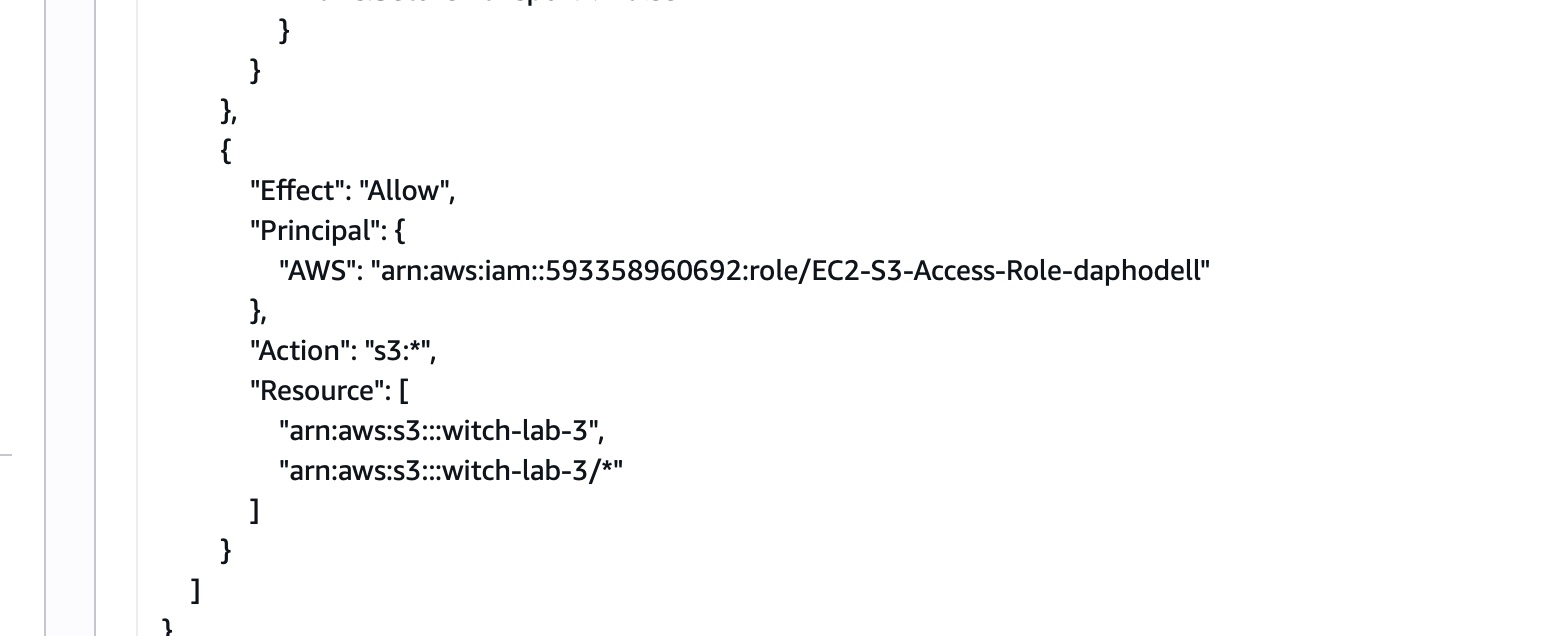
- Create a bucket policy that blocks all public access but allows your IAM role
- Implmented: guide
<<<<<<< HEAD


1437cee (Add resume pdf & html)
- Experiment with requiring MFA or VPC conditions.
- MFA conditions
- MFA did not work out of the box after setting it in the s3 bucket policy. The ways I found you can configure MFA:
- stackoverflow
- official guide
- via cli roles - I set up a new set of role-trust relationships. Update s3 Role: Update action: sts:assumerole Update principle (for user -- could not target group) Add condition (MFA bool must be true)
- Commands referenced: I set up a script that looks like this
- MFA conditions
MFA_TOKEN=$1

if [ -z "$1" ]; then
  echo "Error: Run with MFA token!"
  exit 1
fi

if [ -z $BW_AWS_ACCOUNT_SECRET_ID ]; then
  echo "env var BW_AWS_ACCOUNT_SECRET_ID must be set!"
  exit 1
fi

AWS_SECRETS=$(bw get item $BW_AWS_ACCOUNT_SECRET_ID)

export AWS_ACCESS_KEY_ID=$(echo "$AWS_SECRETS" | jq -r '.fields[0].value')
export AWS_SECRET_ACCESS_KEY=$(echo "$AWS_SECRETS" | jq '.fields[1].value' | tr -d '"')

SESSION_OUTPUT=$(aws sts assume-role --role-arn $S3_ROLE --role-session-name $SESSION_TYPE --serial-number $MFA_IDENTIFIER --token-code $MFA_TOKEN)
#echo $SESSION_OUTPUT
export AWS_SESSION_TOKEN=$(echo "$SESSION_OUTPUT" | jq '.Credentials.SessionToken' | tr -d '"')
export AWS_ACCESS_KEY_ID=$(echo "$SESSION_OUTPUT" | jq '.Credentials.AccessKeyId' | tr -d '"')
export AWS_SECRET_ACCESS_KEY=$(echo "$SESSION_OUTPUT" | jq '.Credentials.SecretAccessKey' | tr -d '"')
#echo $AWS_SESSION_TOKEN
#echo $AWS_ACCESS_KEY_ID
#echo $AWS_SECRET_ACCESS_KEY
aws s3 ls s3://witch-lab-3
* configuration via ~/.aws/credentials
* 1Password CLI with AWS Plugin
  * I use bitwarden, which also has an AWS Plugin
  * I've seen a lot more recommendations (TBH it's more like 2 vs 0)
    for 1password for password credential setup. Wonder why?
- Host a static site
- Enable a static website hosting (
index.html) - Configure route 53 alias or CNAME for
resume.<yourdomain>to the bucket endpoint. - Deploy CloudFront with ACM certificate for HTTPS
- see: resume <<<<<<< HEAD
- Enable a static website hosting (
- Private "Invite-Only" Resume Hosting
- Pre-signed URLs
aws s3 presign s3://<YOUR_BUCKET_NAME>/resume.pdf --expires-in 3600=======
- Cloudflare Edge Certificate -> Cloudfront -> S3 Bucket
- In this step, I disabled "static website hosting" on the s3 bucket Private "Invite-Only" Resume Hosting
- Pre-signed URLs
- Pre-signed URLs
aws s3 presign s3://<YOUR_BUCKET_NAME>/resume.pdf --expires-in 3600

1437cee (Add resume pdf & html)
Further Exploration
- Snapshots & AMIs
- Create an EBS snapshot of
/dev/xvda - Register/create an AMI from that snapshot
- How do you "version" a server with snapshots? Why is this useful?
- Launch a new instance from your AMI
- Linux & Security Tooling
- Scripting & Automation
- Bash: report world-writable files
- Python with boto3: list snapshots, start/stop instances
Further Reading
Reflection
-
What I built
-
Challenges
- Groups cannot be used as the principal in a trust relationship
- The stretch goal for setting up s3 + mfa was a bit of a pain:
- The earlier lab had me set up a trust relationship on the role to allow EC2 as a principal on the role When I later updated IAM permissions to include MFA, I promptly forgot about this detail and had chatgpt help me with troubleshooting. It was pretty good at helping me figure out the issue
-
Security concerns On scale and security at scale
Terms
Identity Access Management
graph LR
  IAMPolicy -- attaches to --> IAMIdentity
  ExplainIAMIdentity[users, groups of users, roles, AWS resources]:::aside
  ExplainIAMIdentity -.-> IAMIdentity
classDef aside stroke-dasharray: 5 5, stroke-width:2px;
End lab
- On June 20, 2025, do the following:
- Clean up
- Custom roles
- Custom policies
- Shut down ec2 Instance
- Clean up